Dog body language chart: every signal explained (free printable)
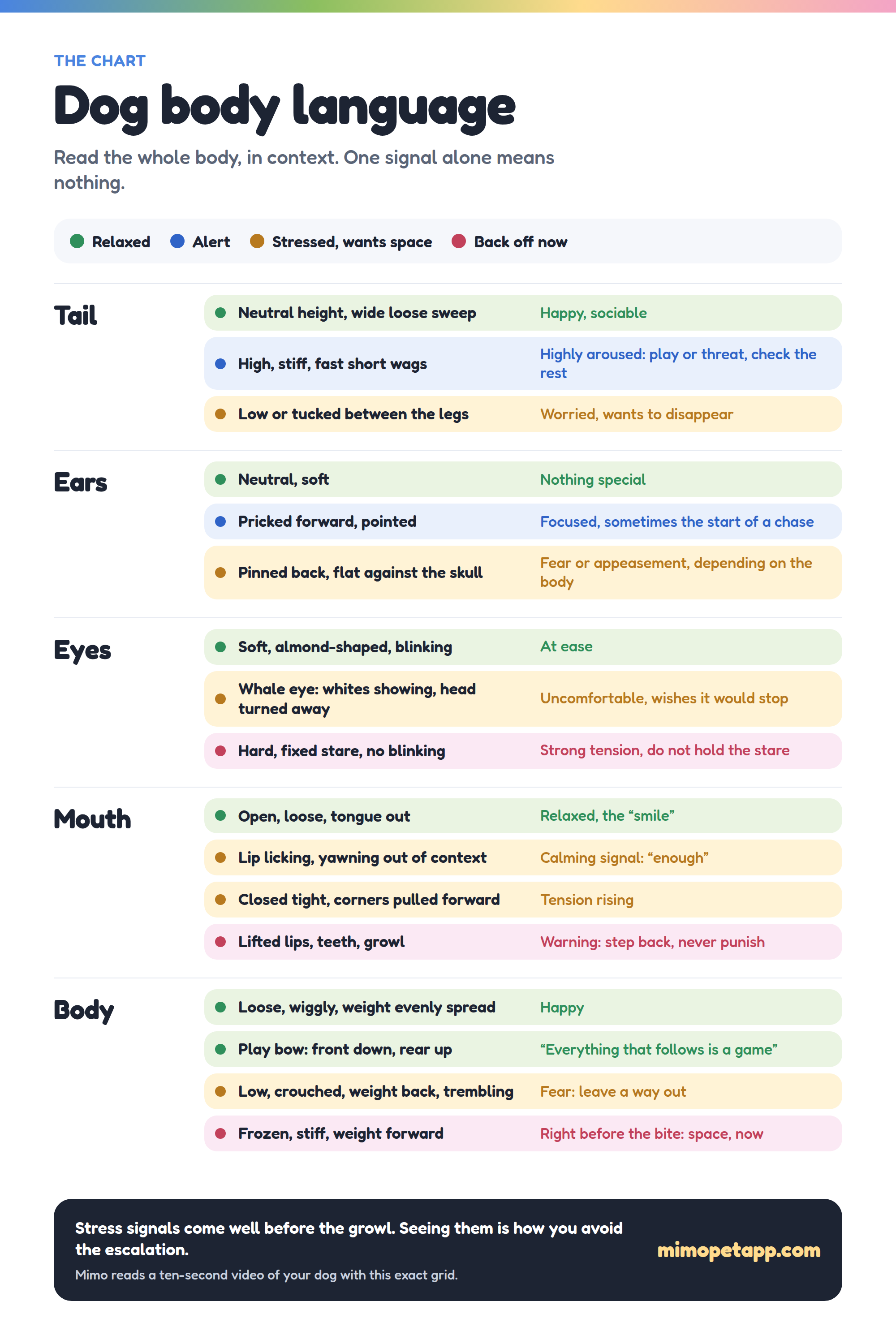
A dog speaks with his whole body, all at once: the tail says one thing, the ears refine it, the mouth and eyes settle it, and the context gives it meaning. That is why a “tail up = happy” chart does not work: the same high tail can announce a game or a bite. The chart below is built differently, by body part, with signals read together and sorted by state: relaxed, alert, stressed, or “back off now”.
You can download it as an image, print it for the fridge, the vet’s waiting room or the kids’ classroom, and share it freely. The rest of the article explains every line, the misreads that cost bites, and the ladder of escalation everyone should know.
The chart, and how to use it
Read it line by line: every body part has its signals, from most relaxed to most tense. Then cross-check: a dog is not relaxed because his tail wags, he is relaxed if his tail wags, his mouth is soft, his eyes are soft and his body wiggles. As soon as two lines contradict each other, wagging tail but stiff body, for instance, tension wins.
The tail
Height tells you the arousal level, movement tells you the emotion, and stiffness tells you the tension. A tail at neutral height, the breed’s resting height, sweeping wide and loose: a happy dog. A high, stiff tail wagging fast in short strokes: a highly aroused dog, who can tip into play as easily as into threat; look at the rest. A low or tucked tail: worry, wanting to disappear. Studies even show an asymmetry: a wag that leans right goes with positive emotions, left with negative ones. Mind docked or curled tails, like the Husky’s: the tail is harder to read there, so you lean on the rest. More in our page on tail wagging.
The ears
Ears show where the attention goes and how the dog feels about what he is looking at. Neutral and soft: nothing special. Pricked forward, pointed at something: alert, focus, sometimes the start of a chase or a guard. Pinned back, flat against the skull: fear or appeasement, depending on the rest of the body; a dog greeting you with ears back and a wiggling body is happy to see you, a frozen dog with ears back is afraid. In drop-eared breeds like the Labrador, read the base of the ear, which still moves forward or back.
The eyes
Soft, almond-shaped eyes, sometimes squinted, with blinks: a dog at ease. A hard, fixed stare, round pupils, no blinking: strong tension, often right before a growl or a bite; never hold that stare, look away and move off. Whale eye, when the dog turns his head away but keeps his eyes on you, showing the whites: an uncomfortable dog who wishes it would stop, very common during tight hugs and photos with kids. A clear head turn, on the other hand, is a calming signal: “I am not looking for conflict”.
The mouth
The most reliable part, and the least watched. Open, loose mouth, tongue out, relaxed corners: a happy dog, the famous “smile”. Closed, tight mouth, corners pulled forward: tension rising; in a dog who was playing open-mouthed, the sudden closing of the mouth is the sign not to miss. Lip licking and yawning out of context, no food and no tiredness: calming signals, the dog is settling himself or asking to be left alone. Lifted lips, visible teeth, a growl: a clear warning, which you thank by stepping back, and never punish, or you remove the warning and keep the bite.
Body and posture
Loose body, wiggling, weight evenly spread, round movements: relaxed. The play bow, front end down and rear end up: “everything that follows is a game”, even if it looks rough. A frozen, stiff body, weight forward, often with a fixed stare: peak tension, and the step that usually precedes the bite; do not touch, do not approach, give space. A low, crouched body, weight back, sometimes trembling: fear; a frightened dog who cannot flee ends up defending himself. And the dry shake-off, like after a bath but with no water: the dog resetting after a tense moment, a good sign.
The ladder of escalation
Dogs almost always warn, and in a fairly constant order, which veterinary behaviorist Kendal Shepherd described as a ladder. At the bottom, the discreet signals: yawning, lip licking, turning the head away. Then turning the whole body away, walking off, lying down with a paw raised. Then freezing, growling. Then snapping at the air. And finally biting. A dog whose lower rungs are ignored or punished learns to skip them, and you get the famous “he bit without warning”: he had warned, at the bottom of the ladder, for months.
That is what the chart is for: seeing the first rungs. For kids, the simple rule is “if the dog turns his head away, licks his lips or goes stiff, we stop and step back”.
The three misreads that cost the most
Three wrong readings come up in almost every “unexplained” bite.
- A wagging tail means happy. No: it means aroused. High, stiff, fast, with a frozen body, that is a threat wagging its tail.
- An exposed belly means “rub me”. Sometimes. But a dog on his back, stiff, tail between his legs, eyes averted, is saying “I give up, leave me alone”: touching him then often triggers the bite.
- A yawn means tired. During a hug, a photo, at the vet, a yawn is a stress signal. The dog is asking you to stop.
Print, share, go further
The image is free to use, with credit to mimopetapp.com: fridge, vet clinic, classroom, shelter, forum, Pinterest. The printable version fits on one letter or A4 page. For every signal, the question pages on this site detail what to look at and what to do, and our complete dog body language guide goes deeper on each body part, with the calming signals in detail.
And if you want a reading of your own dog, in the real scene, ten seconds of video are enough for Mimo, which applies exactly this grid, with a confidence level.
Frequently asked questions
Does a wagging tail mean the dog is happy?
Not always. It means the dog is aroused. A tail sweeping wide and loose with a soft body, yes, that is joy. A high, stiff tail wagging fast and short with a frozen body is strong tension. Always look at the rest of the body.
What does “whale eye” mean?
The dog turns his head away but keeps his eyes on what worries him, and you see the white of the eye in a crescent. It is a sign of discomfort: he wishes it would stop, often during a hug, a photo, or when someone approaches his bowl. Step back and give him space.
Why does my dog yawn when I hug him?
Because a tight hug, for a dog, is a constraint: he cannot move away. The yawn is a calming signal, his way of saying “this is a lot”. Most dogs prefer brief contact on the side, which they can leave.
Can I print and share the chart?
Yes, freely, with credit to mimopetapp.com. Download the 1000 × 1500 image or open the printable version, which fits on one page. For commercial use, write to us.
Updated on October 6, 2026. Mimo reads behavior. It does not replace a vet.